The short answer
- Most repeat trips come from an overloaded circuit, a short circuit or a ground fault.
- Reset a breaker only once. If it trips again right away, leave it off and call.
- Never tape a breaker on or swap in a bigger one. That removes the fire protection.
- A breaker that is hot, buzzing or won't stay on usually needs replacing.
What a breaker actually does
Every circuit in your home runs through a breaker in your panel. The breaker watches how much current flows. When the flow gets too high, or something goes wrong, it snaps off in a split second. That stops wires from overheating inside your walls.
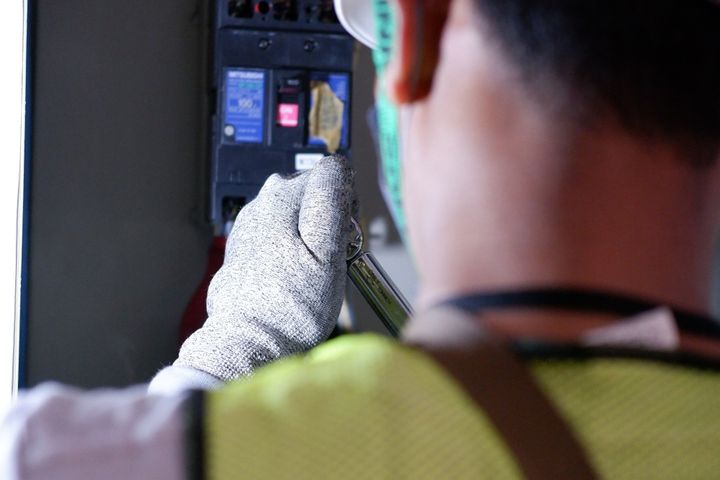
A tripped breaker usually sits in the middle, between ON and OFF. That's why it can be hard to spot in a dark garage or basement.
Seven reasons a breaker keeps tripping
1. Too much on one circuit
This is the most common cause. A space heater, hair dryer or microwave can pull a lot of power. Run two of them on the same circuit and the breaker trips. Kitchens, bathrooms and home offices are frequent trouble spots.
2. A short circuit
A short happens when a hot wire touches a neutral wire. Current rushes through with almost no resistance. You may hear a pop or see a scorch mark on an outlet. A short needs a repair, not just a reset.
3. A ground fault
A ground fault is current leaking to ground, often through water. Outdoor outlets, bathrooms and garages see this most. These spots usually have GFCI protection, which trips fast to prevent shock. Our guide to GFCI vs AFCI Protection explains how it works.
4. An arc fault
Arc-fault breakers (AFCIs) trip when they sense sparking in wiring or cords. A damaged lamp cord or a loose wire in a wall box can set one off. Bedrooms and living areas in newer homes often have these.
5. A worn-out breaker
Breakers wear out after years of use. An old breaker can trip too easily, or worse, fail to trip at all. Heat, a buzzing sound or a handle that feels loose are warning signs.
6. A loose connection
A loose wire at an outlet, switch or in the panel creates heat. Heat makes the breaker trip. Brown marks on a cover plate or a warm outlet point to this problem.
7. A failing appliance
Sometimes the circuit is fine and the appliance is not. A fridge, AC unit, garbage disposal or treadmill with a worn motor can trip a breaker every time it starts.
How to reset a tripped breaker safely
- Unplug or switch off things on that circuit, like heaters, lamps and chargers.
- Find the breaker that sits in the middle or shows a red or orange flag.
- Push it firmly to OFF until you feel a click.
- Push it back to ON. Stand to the side of the panel, not directly in front.
- Plug things back in one at a time. If it trips when one item goes in, that item or that load is the cause.
Stop if it trips again right away. A breaker that trips the moment you reset it, with nothing plugged in, points to a short or a failing breaker. Leave it off and call an electrician.
Never tape a breaker on, hold it in place or replace it with a larger breaker. The breaker size matches the wire size. A bigger breaker lets wires overheat before it trips.
When it trips tells you why
Pay attention to timing. It is the best clue you have.
| When it trips | Likely cause | What to do |
|---|---|---|
| When a heater or microwave runs | Overloaded circuit | Move the load, or add Dedicated Circuits and 240V Outlets |
| The instant you reset it | Short circuit or bad breaker | Leave it off and book Electrical Troubleshooting |
| During rain or snowmelt | Ground fault from moisture | Check outdoor outlets and covers |
| At random, often in bedrooms | Arc fault in a cord or wire | Check lamp cords, then call if it repeats |
| Breaker feels hot or buzzes | Worn breaker or loose connection | Schedule Breaker Repair and Replacement |
When tripping points to a bigger problem
Sometimes the trips are a symptom of a panel that can't keep up. If you're adding an EV charger, hot tub or new AC, read 100 Amp vs 200 Amp Service before you buy. A Panel Upgrade may be the long-term fix.
Older panels deserve extra care. Some Federal Pacific and Zinsco panels have breakers with a history of failing to trip. If your home has one, a licensed electrician should look at it, even if nothing is tripping.
When to call an electrician
- The breaker trips again right after a reset.
- You see scorch marks, smell burning or hear buzzing.
- The breaker or panel feels warm.
- The same breaker trips every few days with normal use.
- Lights dim or flicker when big appliances start.
We find the cause, fix it and test the circuit before we leave. If it's urgent, our 24/7 Emergency Electrical Repair team answers day and night.